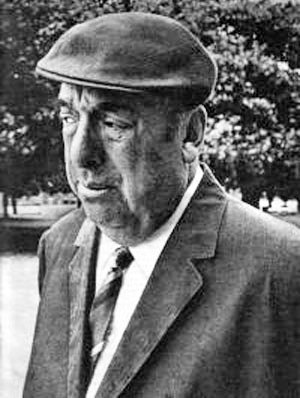
In 1921, he moved to Santiago to study French at the Universidad de Chile with the intention of becoming a teacher, but soon Neruda was devoting himself full time to poetry. In 1923 his first volume of verse, Crepusculario ("Book of Twilights"), was published, followed the next year by Veinte poemas de amor y una canción desesperada ("Twenty Love Poems and a Song of Despair"), a collection of love poems that was controversial for its eroticism, especially considering its author's young age. Both works were critically acclaimed and were translated into many languages. Over the decades, Veinte poemas would sell millions of copies and become Neruda's best-known work.I wonder what he was hoping for?
Neruda had one daughter, Malva Marina Trinidad (1934–1943), living in Gouda, The Netherlands. She died at age eight in 1942. (This was after veinte poemas)
Neruda was good friends with Venezuelan intellectuals and diplomats, such as Arturo Uslar Pietri, Juan Oropeza and Miguel Otero Silva.
Neruda always wrote in green ink because it was the color of Esperanza (hope).
Jan Neruda:
Pablo Neruda chose his pen name in honour of the famous Czech poet Jan Neruda.
Jan Neruda was born in Prague, Bohemia, son of a small grocer who lived in the Malá Strana (Lesser Quarter) district of Prague. After studying philosophy and philology, he worked as a teacher until 1860, when he became a freelance journalist and writer. Neruda never married but had a close relationship to the writer Karolína Světlá.I see a few similarities between Pablo and Jan:
In his work Neruda promoted the idea of rebirth of Czech patriotism. He participated in all the central cultural and political struggles of his generation, and gained a reputation as a sensitive critic. Neruda became, with Vítězslav Hálek, the most prominent representative of the new literary trends.
Neruda was known for his satirical depiction of the petty bourgeois of Prague. His most popular prose work is "Povídky malostranské" (1877, Tales of the Little Quarter), a collection of short stories, which was translated into English in 1957 by the novelist and mystery writer Ellis Peters. Neruda's stories take the reader to the Lesser Quarter, to its streets and yards, shops, churches, houses, and restaurants.
- Both switched from teaching to writing
- Both involved in politics
- Both write in opposition of their government
During the late 1960s, Argentine writer Jorge Luis Borges was asked for his opinion of Pablo Neruda. After describing a brief meeting with him when both were young, Borges stated,This may be interesting to mention if I focus on Neruda's opinion of the impact of voiced words.
"I think of him as a very fine poet, a very fine poet. I don't admire him as a man, I think of him as a very mean man."When asked for the reasons for this, Borges continued,
"Well, he wrote a book -- well, maybe here I'm being political -- he wrote a book about the tyrants of South America, and then he had several stanzas against the United States. Now he knows that that's rubbish. And he had not a word against Perón. Because he had a lawsuit in Buenos Aires, that was explained to me afterwards, and he didn't care to risk anything. And so, when he was supposed to be writing at the top of his voice, full of noble indignation, he had not a word to say against Perón. And he was married to an Argentine lady, he knew that many of his friends had been sent to jail. He knew all about the state of our country, but not a word against him. At the same time, he was speaking against the United States, knowing the whole thing was a lie, no?

