Wednesday, May 19, 2010

Tuesday, May 18, 2010
Blood Wedding Journal #2
Creative: Diary entries from any of the characters.
Dear Diary,
It is the night before my wedding, and I am nervous. I know that I simply cannot go through with marrying this man. I also know that I am still in love with Leonardo. We have decided to run away together where we can live in peace without the pressure of being in our own unhappy marriages. Him with his wife and I with my husband, neither of us will find happiness. That is why we must leave this place and go away together. As soon as I get a chance to be alone, I will find him and take him away with me. My Father will no doubt be crushed upon losing his daughter and a chance at grandsons, and I will be the talk of the town. There will be no going back. Leonardo and I will surely be dead if we ever are caught. Yes, I am dreading my wedding tomorrow, but I am waiting in earnest to finally be alone with my love, Leonardo.
With Love,
The Bride
Dear Diary,
It is the night before my wedding, and I am nervous. I know that I simply cannot go through with marrying this man. I also know that I am still in love with Leonardo. We have decided to run away together where we can live in peace without the pressure of being in our own unhappy marriages. Him with his wife and I with my husband, neither of us will find happiness. That is why we must leave this place and go away together. As soon as I get a chance to be alone, I will find him and take him away with me. My Father will no doubt be crushed upon losing his daughter and a chance at grandsons, and I will be the talk of the town. There will be no going back. Leonardo and I will surely be dead if we ever are caught. Yes, I am dreading my wedding tomorrow, but I am waiting in earnest to finally be alone with my love, Leonardo.
With Love,
The Bride
Monday, May 17, 2010
Blood Wedding Journal #1
Discussion: Point of View/Characters: From whose point of view is the story told? Does this change? How reliable is the narrative voice? How well does the reader get to know the characters? How credible are they? How are they presented? How does the writer persuade us to like/sympathize with some characters and dislike others?
(I will start with the characters in Act I and probably add to this as we read further on)
Bridegroom: He is one of the first two characters we meet in the play. We immediately learn about his sad family history and feel sorry for his loss, but also look forward to his future life with his new life. Later on, when we see him interacting with the bride, we notice that he loves her more than she loves him. Also, the bride is not at all interested in marrying him. It makes us wonder why they are getting married in the first place, and it makes the bridegroom look foolish because he can't see that she doesn't want him.
Mother: She is one of the first two characters we meet in the play. We immediately learn about her sad family history and feel sorry for her loss, but also feel sorry that she will soon be losing her son when he gets married. She seems kind of crazy because she is obsessing over knives and cannot let go of her dead loved ones and keeps shifting the conversation towards them.
Wife: Because she begins by singing to her baby in a poetic sort of way, she seems very loving and tender. However, (to me at least) she soon seems kind of nagging and clingy towards Leonardo. She also appears to be jealous of his former relationship with the bride. Later in the play, it is revealed that her relationship with Leonardo is very tense and strained.
Leonardo: Leonardo comes into the play and seems to be busy and short-tempered. Later on, it seems that he is only curt with his wife, and it becomes obviously that he truly loves the bride and not his wife. However, I did not feel sympathy for the wife because it seemed like everyone else was against Leonardo. It also seemed very sad to me that Leonardo and the bride love each other but are not together.
Father: The father doesn't seem to play a huge role, but he does seem very concerned with having sons to do his work. This contrasts with the mother's concern with having daughters because the sons will always leave, but daughters spend time with you.
Bride: The bride is my favorite character in the play because she seems to have the most going on. She is marrying one guy, but she doesn't really love him. In fact, it seems that she even hates him because she is always telling him to leave her alone. I always start laughing when he refers to their "alone time" and she seems kind of grossed out by it. While she is the most deceptive character in the play, I seem to trust her the most because I feel like while she might not be honest with other people, she is definitely honest with herself. Rather than trying to convince herself that she can live happily with the bridegroom, she decides to ditch him at their wedding.
(I will start with the characters in Act I and probably add to this as we read further on)
Bridegroom: He is one of the first two characters we meet in the play. We immediately learn about his sad family history and feel sorry for his loss, but also look forward to his future life with his new life. Later on, when we see him interacting with the bride, we notice that he loves her more than she loves him. Also, the bride is not at all interested in marrying him. It makes us wonder why they are getting married in the first place, and it makes the bridegroom look foolish because he can't see that she doesn't want him.
Mother: She is one of the first two characters we meet in the play. We immediately learn about her sad family history and feel sorry for her loss, but also feel sorry that she will soon be losing her son when he gets married. She seems kind of crazy because she is obsessing over knives and cannot let go of her dead loved ones and keeps shifting the conversation towards them.
Wife: Because she begins by singing to her baby in a poetic sort of way, she seems very loving and tender. However, (to me at least) she soon seems kind of nagging and clingy towards Leonardo. She also appears to be jealous of his former relationship with the bride. Later in the play, it is revealed that her relationship with Leonardo is very tense and strained.
Leonardo: Leonardo comes into the play and seems to be busy and short-tempered. Later on, it seems that he is only curt with his wife, and it becomes obviously that he truly loves the bride and not his wife. However, I did not feel sympathy for the wife because it seemed like everyone else was against Leonardo. It also seemed very sad to me that Leonardo and the bride love each other but are not together.
Father: The father doesn't seem to play a huge role, but he does seem very concerned with having sons to do his work. This contrasts with the mother's concern with having daughters because the sons will always leave, but daughters spend time with you.
Bride: The bride is my favorite character in the play because she seems to have the most going on. She is marrying one guy, but she doesn't really love him. In fact, it seems that she even hates him because she is always telling him to leave her alone. I always start laughing when he refers to their "alone time" and she seems kind of grossed out by it. While she is the most deceptive character in the play, I seem to trust her the most because I feel like while she might not be honest with other people, she is definitely honest with herself. Rather than trying to convince herself that she can live happily with the bridegroom, she decides to ditch him at their wedding.
Sunday, May 16, 2010
Wild Duck Journal #5 - Tracking
I have been tracking the truth in Oedipus and Wild Duck.
In Oedipus, it seems like the revelation of the truth is seen as a good thing, and the right thing to do. Oedipus knows that finding out the truth could destroy him, but he is determined to find it out anyway. Once he does, he blinds himself and the play ends with him preparing for exile. This mindset that finding out what it true and good is more important than a single person's happiness makes it seem like the truth should always be revealed. Even though the truth led to destruction, this destruction was not really a bad thing (because it led to the restoration of Thebes).
In Wild Duck, however, the revelation of the truth is a bad thing. Gregers is determined to show Hjalmar the truth about his wife and his family because he believes that it will make him a stronger man (similar to the message in Oedipus), but in the end it just ends up destroying his family and leaving him in a state of despair over his dead daughter. This broken family contrasts with the content family we see in the first few acts to show us that we can live happily while believing lies, or we can live miserably when we know the truth. In this situation, it is reasonable to infer that Ibsen believes that it is not always necessary to be completely truthful. He shows that in reality, a lie is sometimes the better option because it keeps things from getting too crazy.
In Oedipus, it seems like the revelation of the truth is seen as a good thing, and the right thing to do. Oedipus knows that finding out the truth could destroy him, but he is determined to find it out anyway. Once he does, he blinds himself and the play ends with him preparing for exile. This mindset that finding out what it true and good is more important than a single person's happiness makes it seem like the truth should always be revealed. Even though the truth led to destruction, this destruction was not really a bad thing (because it led to the restoration of Thebes).
In Wild Duck, however, the revelation of the truth is a bad thing. Gregers is determined to show Hjalmar the truth about his wife and his family because he believes that it will make him a stronger man (similar to the message in Oedipus), but in the end it just ends up destroying his family and leaving him in a state of despair over his dead daughter. This broken family contrasts with the content family we see in the first few acts to show us that we can live happily while believing lies, or we can live miserably when we know the truth. In this situation, it is reasonable to infer that Ibsen believes that it is not always necessary to be completely truthful. He shows that in reality, a lie is sometimes the better option because it keeps things from getting too crazy.
Saturday, May 15, 2010
Wild Duck Journal #4
Comparison: Compare how writers in your study have explored the theme of judgment and punishment and with what effect.
In Oedipus, it seems that the end of the novel acts as a sort of "judgment day." It is at this point that we see who Oedipus really is, and he punishes himself with blindness and exile. However, in ancient Greece, this could have been seen as the honorable thing to do. While he is punished with this fate, he is also judged by it. Because he chooses to "take the high road" by living in blindness and exile, he could be seen as heroic and noble.
In Wild Duck, Gregers is very concerned with his ideal image of a man, in this case Hjalmar. He believes that through informing Hjalmar about his wife's past relationship, Hjalmar will be a better man for it. However, once Hjalmar learns of this secret, he abandons his family and becomes miserable. It becomes evident that Hjalmar is not the "ideal man" because of his reaction. He is punished for his behavior when it results in his daughter's suicide and we see him regret his actions.
In Oedipus, it seems that the end of the novel acts as a sort of "judgment day." It is at this point that we see who Oedipus really is, and he punishes himself with blindness and exile. However, in ancient Greece, this could have been seen as the honorable thing to do. While he is punished with this fate, he is also judged by it. Because he chooses to "take the high road" by living in blindness and exile, he could be seen as heroic and noble.
In Wild Duck, Gregers is very concerned with his ideal image of a man, in this case Hjalmar. He believes that through informing Hjalmar about his wife's past relationship, Hjalmar will be a better man for it. However, once Hjalmar learns of this secret, he abandons his family and becomes miserable. It becomes evident that Hjalmar is not the "ideal man" because of his reaction. He is punished for his behavior when it results in his daughter's suicide and we see him regret his actions.
Friday, May 14, 2010
Wild Duck Journal #3
Comparison: What are the questions that underlie at least two of the works that you have read and how have the authors sought to answer those questions?
One major question asked by the two plays we have read so far is: Should the truth come out or be kept secret? Are we better off happy in our ignorance, or miserable in knowing the truth?
In Oedipus, this question definitely receives an answer. Sophocles show us that we should always strive toward the truth rather than settling for lies. Once everyone knows the truth, Jocasta kills herself and Oedipus blinds himself and prepares for exile. However, we also realize that his city is saved now that he is gone. In ancient Greek times, to die in battle protecting your city was honorable. Oedipus' exile is for the benefit of Thebes, and could therefor be seen as heroic. Also in those times, the great playwrights were basing their stories off of the "ideal man." Because we see this "ideal man" determined to find the truth, the message of the play is that a good man will always try to find the truth, no matter the cost. Even our own destruction should not keep us from discovering what is right.
In Wild Duck, Hjalmar's family is ripped apart when the truth about his wife's affair with Mr. Werle comes out. Werle gave money and support to Hjalmar because of this relationship with Gina, and now Hjalmar feels that everything he thought he worked for was a lie. He doesn't know what to believe now, but he knows that he can't trust Gina. He wants nothing to do with his family any longer. Because this play was written in the Modernist time period, it was written to portray real life. It was a movement against Romanticism (which has many connections with the Greek writing style), so it makes sense that the message from this play differs from Oedipus. Ibsen shows, through the Ekdal family's unfortunate outcome, that happiness in a lie is better than misery in the truth. Before the truth was revealed, the Ekdal family did have its problems, but they were still living together, and there are some scenes where they express a great love for each other. This is an accurate representation of real life. However, once Gregers reveals the truth the Hjalmar, this happiness is destroyed and Hedvig commits suicide because her father wants nothing to do with her. This shows us that "ignorance is bliss," and we are sometimes better off living happily in the dark.
One major question asked by the two plays we have read so far is: Should the truth come out or be kept secret? Are we better off happy in our ignorance, or miserable in knowing the truth?
In Oedipus, this question definitely receives an answer. Sophocles show us that we should always strive toward the truth rather than settling for lies. Once everyone knows the truth, Jocasta kills herself and Oedipus blinds himself and prepares for exile. However, we also realize that his city is saved now that he is gone. In ancient Greek times, to die in battle protecting your city was honorable. Oedipus' exile is for the benefit of Thebes, and could therefor be seen as heroic. Also in those times, the great playwrights were basing their stories off of the "ideal man." Because we see this "ideal man" determined to find the truth, the message of the play is that a good man will always try to find the truth, no matter the cost. Even our own destruction should not keep us from discovering what is right.
In Wild Duck, Hjalmar's family is ripped apart when the truth about his wife's affair with Mr. Werle comes out. Werle gave money and support to Hjalmar because of this relationship with Gina, and now Hjalmar feels that everything he thought he worked for was a lie. He doesn't know what to believe now, but he knows that he can't trust Gina. He wants nothing to do with his family any longer. Because this play was written in the Modernist time period, it was written to portray real life. It was a movement against Romanticism (which has many connections with the Greek writing style), so it makes sense that the message from this play differs from Oedipus. Ibsen shows, through the Ekdal family's unfortunate outcome, that happiness in a lie is better than misery in the truth. Before the truth was revealed, the Ekdal family did have its problems, but they were still living together, and there are some scenes where they express a great love for each other. This is an accurate representation of real life. However, once Gregers reveals the truth the Hjalmar, this happiness is destroyed and Hedvig commits suicide because her father wants nothing to do with her. This shows us that "ignorance is bliss," and we are sometimes better off living happily in the dark.
Wednesday, May 12, 2010
Wild Duck Journal #2
Comparison: "Although doubt is not a pleasant condition, certainty is an absurd one." In the light of this statement, explore the impressions of doubt and/or certainty conveyed in at least two works you have studied.
In Oedipus, the people of Thebes ask Oedipus to find the killer of Lauis so that they can be free of the plague. As he gains more information, Oedipus discovers coincidences that lead him to suspect himself of killing his father. When Jocasta hears of this, she dismisses it and urges him not to push the matter any further. However, Oedipus is determined to uncover the truth. If he had not felt the need to be certain about his heritage, he would not have discovered the truth about who he is and what he had done. Then, Jocasta may not have killed herself and Oedipus would probably not have blinded himself. Oedipus' need for certainty is what leads to his destruction. However, when Jocasta's initial certainty that Oedipus is not her son wavers and she realizes what happens, she cannot live with the truth. It appears that this false certainty has a different meaning than the certainty in the truth. It could be that being certain of something something which you have no proof of (blind belief), or certainty in a lie, leads to Jocasta's destruction.
In Wild Duck, Gregers is obsessed with telling Hjalmar the truth about his wife's involvement with Mr. Werle, leading Hjalmar to question whether or not Hedvig is his biological daughter. When he first realizes that Hedvig may not be his daughter, he does not hesitate to basically freak out and walk out on his family. He does this because he has doubts, but he is not certain. He leaves before he takes the time to know for sure who the real father is. This lack of a need for certainty leaves us without knowledge of who her real father is. Because of this, it is possible that Hjalmar is indeed the father. Opposite of Oedipus, Hjalmar feels no need to know for certain. His acting on doubts brings his certain destruction. While the reader cannot know what would have happened if he had waited until he was certain, the reader also cannot know for certain if Hjalmar would have had the same fate.
In Oedipus, the people of Thebes ask Oedipus to find the killer of Lauis so that they can be free of the plague. As he gains more information, Oedipus discovers coincidences that lead him to suspect himself of killing his father. When Jocasta hears of this, she dismisses it and urges him not to push the matter any further. However, Oedipus is determined to uncover the truth. If he had not felt the need to be certain about his heritage, he would not have discovered the truth about who he is and what he had done. Then, Jocasta may not have killed herself and Oedipus would probably not have blinded himself. Oedipus' need for certainty is what leads to his destruction. However, when Jocasta's initial certainty that Oedipus is not her son wavers and she realizes what happens, she cannot live with the truth. It appears that this false certainty has a different meaning than the certainty in the truth. It could be that being certain of something something which you have no proof of (blind belief), or certainty in a lie, leads to Jocasta's destruction.
In Wild Duck, Gregers is obsessed with telling Hjalmar the truth about his wife's involvement with Mr. Werle, leading Hjalmar to question whether or not Hedvig is his biological daughter. When he first realizes that Hedvig may not be his daughter, he does not hesitate to basically freak out and walk out on his family. He does this because he has doubts, but he is not certain. He leaves before he takes the time to know for sure who the real father is. This lack of a need for certainty leaves us without knowledge of who her real father is. Because of this, it is possible that Hjalmar is indeed the father. Opposite of Oedipus, Hjalmar feels no need to know for certain. His acting on doubts brings his certain destruction. While the reader cannot know what would have happened if he had waited until he was certain, the reader also cannot know for certain if Hjalmar would have had the same fate.
Tuesday, May 11, 2010
Wild Duck Journal #1
Discussion: Setting: This includes cultural as well as geographical and historical setting. What effect does the setting have on story, character, theme?
The setting of The Wild Duck is completely different from the setting of Oedipus. They are coming from two different time periods and are thus set in two different time periods as well. I feel as though the whole feel of the play is different in The Wild Duck, as is its purpose. While Oedipus seemed like it was meant to be a brief but well-known story (almost like a legend) that was meant to entertain people as well as give them a small lesson in life, The Wild Duck seems much more mature, thoughtful and serious. There is a depth to this play that is not present in Oedipus, and I think that the time period has a lot to do with that.
The setting in The Wild Duck begins at a small social gathering in a home. This makes the play seem more intimate, like we are invisible guests at a private event. The mood is also serious and secretive, which adds to the suspense. There are many more characters in The Wild Duck that in Oedipus, and it makes it more complex and more confusing. Overall, it is kind of hard to adjust to the change in writing styles between the two authors and I see more differences than similarities.
The setting of The Wild Duck is completely different from the setting of Oedipus. They are coming from two different time periods and are thus set in two different time periods as well. I feel as though the whole feel of the play is different in The Wild Duck, as is its purpose. While Oedipus seemed like it was meant to be a brief but well-known story (almost like a legend) that was meant to entertain people as well as give them a small lesson in life, The Wild Duck seems much more mature, thoughtful and serious. There is a depth to this play that is not present in Oedipus, and I think that the time period has a lot to do with that.
The setting in The Wild Duck begins at a small social gathering in a home. This makes the play seem more intimate, like we are invisible guests at a private event. The mood is also serious and secretive, which adds to the suspense. There are many more characters in The Wild Duck that in Oedipus, and it makes it more complex and more confusing. Overall, it is kind of hard to adjust to the change in writing styles between the two authors and I see more differences than similarities.
Monday, May 10, 2010
Bloom's Question #2
Explain/Identify how different characters who try to avoid the prophecy are punished in the end.
Bloom's Question #1
What is the significance of the prophet being blind, and why is the motif of blindness significant?
Friday, May 7, 2010
Oedipus Journal #4
Discussion: Narrative Structure - How has the plot (not the story) been constructed? Are their parts? Is the plot circular? Subplots? How important/effective is the ending? Has everything been revealed by the end or are there unanswered questions? Does this matter? What period of time has been covered? Is time important?
The plot:
However, for this discussion I wanted to focus mainly on the ending of the play. By the end of the play, everything has been revealed, and that is why Oedipus' story comes to an end. The truth all being revealed is what brings Oedipus to his end. I have been tracking "the truth" for the plays, and I realized that the truth comes in two different forms.
The plot:
- Oedipus is a great king, but his city is not doing well. The people want to know why
- Lauis is dead, there is a rumor that whoever killed Lauis has cursed the city
- Oedipus, in order to save his city, is determined to find the cursed killer of Lauis
- Oedipus discovers that he killed his father and married his mother
- Jocasta (his mother/wife) kills himself, Oedipus blinds himself/waits to be exiled
However, for this discussion I wanted to focus mainly on the ending of the play. By the end of the play, everything has been revealed, and that is why Oedipus' story comes to an end. The truth all being revealed is what brings Oedipus to his end. I have been tracking "the truth" for the plays, and I realized that the truth comes in two different forms.
- The truth being slowly revealed throughout the play
- The truth appearing in the text; characters talking about the truth
Thursday, May 6, 2010
Oedipus Journal #3
Creative: A poem written about Oedipus
Oedipus, you are our king,
but what is with this rumor thing?
Word's gotten out, the plague has spread
They says it's all because Laius is dead.
You found the shepherd, he told of the past,
He revealed the fate that you had been cast.
But could this be true? You never told
What can the future of our people hold?
Oedipus, we feel your pain.
O the distress, O the shame!
Only you know what's to be done,
From this truth you cannot run.
It seems that your father died at your hand,
You murdered him that day in the sand.
And now she is gone, who gave you life
This truth was too much for your beloved wife.
Your anger gushes like a stream:
Surely this horror must be a dream.
You'll be crying over your sins for awhile,
while you spend your days waiting in exile.
Oedipus, you are our king,
but what is with this rumor thing?
Word's gotten out, the plague has spread
They says it's all because Laius is dead.
You found the shepherd, he told of the past,
He revealed the fate that you had been cast.
But could this be true? You never told
What can the future of our people hold?
Oedipus, we feel your pain.
O the distress, O the shame!
Only you know what's to be done,
From this truth you cannot run.
It seems that your father died at your hand,
You murdered him that day in the sand.
And now she is gone, who gave you life
This truth was too much for your beloved wife.
Your anger gushes like a stream:
Surely this horror must be a dream.
You'll be crying over your sins for awhile,
while you spend your days waiting in exile.
Wednesday, May 5, 2010
Oedipus Journal #2
Given Prompt: How does the background information on Greek Theater and History inform your reading of Oedipus? Use specific examples to explore the connections between context and content.
This story takes place in ancient Greece, a time which is very different from today. This cultural difference is important to note because much of what happens within the story has to do with how the times were back then. Plays were written for and performed at a festival, and the playwrites competed against each other. Sophocles, the author of Oedipus, was the most innovative and interesting to watch. He had eighteen wins, and never placed lower than second. He often wrote about the ideal man, which I am assuming will not be Oedipus because of his past.
Speaking of his past, there is a lot that we seem to have missed because we have not read Antigone. Instead of reading the story that comes before Oedipus the King, we are simply given this information:
This story takes place in ancient Greece, a time which is very different from today. This cultural difference is important to note because much of what happens within the story has to do with how the times were back then. Plays were written for and performed at a festival, and the playwrites competed against each other. Sophocles, the author of Oedipus, was the most innovative and interesting to watch. He had eighteen wins, and never placed lower than second. He often wrote about the ideal man, which I am assuming will not be Oedipus because of his past.
Speaking of his past, there is a lot that we seem to have missed because we have not read Antigone. Instead of reading the story that comes before Oedipus the King, we are simply given this information:
"Many years have passed since Oedipus solved the riddle of the Sphinx and ascended the throne of Thebes, and now a plague has struck the city."From this, the reader can gather that Oedipus is the king, and that he solved some riddle in order to become the king. However, we do not know who he was before he was king or what the riddle was. I assume that the crowd watching the play would have most likely already seen Antigone before they saw Oedipus the King. This makes them more familiar with the ancient Greek society, as well as with Oedispus' background information, so they would perhaps understand dramatic irony (if it refers to something in Antigone) when I may not.
Tuesday, May 4, 2010
Oedipus Journal #1
Comparison: To what extent would you agree that plot should be valued more highly than style in the work. In your answer you should refer to two or three of the works you have studied.
To me, the plot and the way that the story is set up is the most interesting part, and I think that it holds the most information about the theme. They are setting up a situation in life, and the outcome is supposed to tell us something. For example, the storyline in Oedipus is meant to convey the idea that ignorance is bliss and what we don't know can't hurt us. He goes from a powerful king who is respected by everyone, to a dishonorable man who has killed his father and married his mother, and is now disgusted with himself. His whole life, as well as his power, was a lie. This plot helps to develope a theme. However, the stylistic techniques within the play, such as the motif of blindness, help to bring excitement to the story through heavy foreshadowing, but they also create a second theme. Blindness is a symbol of power and the truth, while sight is weakness and lies. This creates the irony of blind people being able to "see" the truth better than people who can actually see.
However, as I was reading 1984 by George Orwell, I noticed that a lot of the techniques used had more of an effect on me than the actual plot. For example, the motif of mind control very clearly communicated Orwell's fear that an overly powerful government could potentially control the thoughts, as well as the actions, of its people. These small, single instances were more powerful and frightening than the plot of a freethinking man being punished (and tortured) for disagreeing with the government.
I think that there is also a huge difference between the current and ancient writing styles, and that they may have had different uses for different things. For example, there is a ton of foreshadowing in Oedipus, but I feel like the purpose of this is to entertain the audience, whereas today it seems like certain techniques today are used to communicate a certain message.
To me, the plot and the way that the story is set up is the most interesting part, and I think that it holds the most information about the theme. They are setting up a situation in life, and the outcome is supposed to tell us something. For example, the storyline in Oedipus is meant to convey the idea that ignorance is bliss and what we don't know can't hurt us. He goes from a powerful king who is respected by everyone, to a dishonorable man who has killed his father and married his mother, and is now disgusted with himself. His whole life, as well as his power, was a lie. This plot helps to develope a theme. However, the stylistic techniques within the play, such as the motif of blindness, help to bring excitement to the story through heavy foreshadowing, but they also create a second theme. Blindness is a symbol of power and the truth, while sight is weakness and lies. This creates the irony of blind people being able to "see" the truth better than people who can actually see.
However, as I was reading 1984 by George Orwell, I noticed that a lot of the techniques used had more of an effect on me than the actual plot. For example, the motif of mind control very clearly communicated Orwell's fear that an overly powerful government could potentially control the thoughts, as well as the actions, of its people. These small, single instances were more powerful and frightening than the plot of a freethinking man being punished (and tortured) for disagreeing with the government.
I think that there is also a huge difference between the current and ancient writing styles, and that they may have had different uses for different things. For example, there is a ton of foreshadowing in Oedipus, but I feel like the purpose of this is to entertain the audience, whereas today it seems like certain techniques today are used to communicate a certain message.
Step Five
I am in senior seminar right now butI wanted to quickly jot down some observations on what I saw in the presentations in class today:
So, to continue with my journal, I have decided that going in detail on two poems and then adding in just a few lines from the third would seem kind of unprofessional. I will make do with just the two, plus I don't have to finish analyzing the third poem so I will be able to make what I have already perfect.
I finally decided that I will be using a powerpoint (which means I will have to bring in my laptop) so I can have the poems up on the board while I talk about them. I think I will do what Amelia did and first read them aloud, then I will go stanza by stanza (or at least in order from beginning to end, and I will skip over things I do not need - that's allowed, right?) Anyway, so I will read the first poem and analyze it, then read the second and analyze it. Then I will have some sort of conclusion, stating my thesis, which I still need to come up with. I have the idea in my head, I just need to get it down on paper and perfect it.
For my outline, I am going to write it in complete sentences, and then practice probably ten times (between now and second period tomorrow) reading through it aloud. After that I should be comfortable enough to be able to recite it almost word for word. I might also make notecards some words that will help me along if I completely lose my train of thought, which is both possible and probably.
Then I need to write down my Final Analysis, which is kind of confusing to me and I'm not sure exactly how to do it. I'm going to have to read those directions really closely. I looked at Matt's today during first period and it was really long so I'm not exactly looking forward to it. It doesn't help that I also have a reading assignment and journal to do tonight...
As nervous as I am, I am also a little bit excited because I think I have a pretty original and creative topic. I'm also glad that after tomorrow, I will have three tests and two projects out of the way. :)
P.S. - I just made the best spaghetti ever.
- I need to practice and semi-memorize what I am going to say word for word. I really want my presentation to be smooth and I need to make sure what I say will make sense. I know that when I don't know for sure what I'm going to say I tend to repeat myself (a lot!) so I want to prevent that from happening.
- I don't think the overhead is an option for me. I think that writing down on the board would take too long, and passing out paper copies of the poems would be too hard to follow along if I jump around within the poems or between them. I think a powerpoint is my best option, just so I can have the different sections up on the screen for everyone to see what I'm talking about while I am doing my analysis.
- I am not sure if I want to include Poem XX because that was what Amelia's presentation focused on. I haven't really analyzed it as much as the others so I will either just drop it altogether, or only use small bits from it. However, I am not sure if just using little bits and pieces of it will come off as a weak analysis or that I was crunched for time.
So, to continue with my journal, I have decided that going in detail on two poems and then adding in just a few lines from the third would seem kind of unprofessional. I will make do with just the two, plus I don't have to finish analyzing the third poem so I will be able to make what I have already perfect.
I finally decided that I will be using a powerpoint (which means I will have to bring in my laptop) so I can have the poems up on the board while I talk about them. I think I will do what Amelia did and first read them aloud, then I will go stanza by stanza (or at least in order from beginning to end, and I will skip over things I do not need - that's allowed, right?) Anyway, so I will read the first poem and analyze it, then read the second and analyze it. Then I will have some sort of conclusion, stating my thesis, which I still need to come up with. I have the idea in my head, I just need to get it down on paper and perfect it.
For my outline, I am going to write it in complete sentences, and then practice probably ten times (between now and second period tomorrow) reading through it aloud. After that I should be comfortable enough to be able to recite it almost word for word. I might also make notecards some words that will help me along if I completely lose my train of thought, which is both possible and probably.
Then I need to write down my Final Analysis, which is kind of confusing to me and I'm not sure exactly how to do it. I'm going to have to read those directions really closely. I looked at Matt's today during first period and it was really long so I'm not exactly looking forward to it. It doesn't help that I also have a reading assignment and journal to do tonight...
As nervous as I am, I am also a little bit excited because I think I have a pretty original and creative topic. I'm also glad that after tomorrow, I will have three tests and two projects out of the way. :)
P.S. - I just made the best spaghetti ever.
Monday, May 3, 2010
Step Four
I have been looking through the poems in Neruda's Twenty Love Poems and a Song of Despair, and I have decided that I will be using two (possibly three) poems for my presentation:
Here is what I have so far:
- Poem V
- Poem XIII
- Poem XX (possibly)
Here is what I have so far:
- "So that you will hear me / my words / sometimes grow thin / as the tracks of the gulls on the beaches." - He is saying that in order for her to "hear" him, he will use few words (or none at all)
- "Necklace, [... ] / for your hands" & "I am making them into an endless necklace for your white hands" - He talks about making his words into a necklace (which would be worn around a neck) for her to wear around her hands (which more resembles a bracelet). Something about a misinterpretation.
- "I watch my words from a long way off" - he feels a distance between himself and his words. He acknowleges the difference between what he feels inside and what he is able to communicate through speech.
- "You listen to other voices in my painful voice" - The idea of selective hearing, she is hearing a message that is different from what he was trying to deliver. Words/Voices are inadequate at relaying the true meaning that comes from within the human mind.
- "My words become stained with your love." Perhaps this has something to do again with her hearing what she wants to hear, rather than what he is really saying. Somehow, his words are being changed (in a negative way).
- What is the significance of grapes? What to they simbolize? Do they have to do with what I am talking about? Do they argue against it?
- What is the "drunken bell" in line 5? Why is it on the same line as the necklace? Does it hurt my analysis if I neglect to mention it? Would it help me if I did?
- Why does Neruda repeat the phrase "You ______ everything, you ______ everything." Could I use that to my advantage?
- "Between the lips and the voice something goes dying." - Again, we have a very clear indication that he is saying that his words do not convey his true meaning. Perhaps voices have a mind of their own?
- "The way nets cannot hold water." - Continues the idea above. His words are not strong enough to capture the essence of his emotions. They have holes; his words cannot carry/hold on to his message.
- "Something climbs to my ravenous mouth." - This makes me think of an intruder of some kind. If he is referring to the voices, and calling them "something," this makes them seem like something unknown to him. They are not under his control.
- "Oh to be able to celebrate you with all the words of joy." - He separates the word joy from the meaning that it is assigned to. He distinguishes the difference between what we feel inside and the word that we use to describe it. He believes that this difference is huge and that it affects how we communicate with others.
Sunday, May 2, 2010
Step Three
Maybe Neruda thinks he can write the saddest lines, but I think I have one line that is infinitely sadder than any of his:
The hardest part is simply that I feel like I have no idea what I'm doing. I am currently struggling to decide how exactly I will present my IOP. I was thinking about doing a class discussion, because the class generally has a lot to say when we are analyzing poems. This sounded like the recipe for a perfect presentation, but I don't think the class would work with me on this topic because Kacey would just talk about sex the whole time and Hiro would talk about totalitarianism. I suppose I could just do my best not to call on them, but where's the fun in that?
Another option would be to demonstrate Neruda's belief that communication through a form other than speech is sometimes more effective, but I don't know whether or not that would help my grade. I feel like I could grab the classes attention if i stood up there and painted a picture or drew one on the white board (which reminds me i need to buy some of those for extra credit!), but I'm not sure if that is something that I could do for an IOP. It would be an interesting way to introduce my idea though, and it would help me to change their thinking about what he is saying. I think I might keep this idea and use it as a quick introduction if it doesn't work in a larger role.
I might just end up using overheads of a few of his poems and pointing out all of the parts that support what I'm saying, but that is boring, AND I don't know if that's good enough for an IOP. I think that if i have 10-15 minutes, I will aim for 13 to be safe.
"I don't know how I'm going to get my IOP done on time and I'm going to get a terrible grade."Anyway, I just spent the entire weekend doing homework: I had to study for a biology test and a math test, write a 2000 word paper for history, and prepare for the poetry commentary test (which, in all honesty, consisted of trading off between praying to the god of poetry to help me analyze the poem and watching The Breakfast Club to get my mind off of it). Oh, and I helped cut down a tree in my backyard. I somehow managed to forget (again with the honesty: avoid) doing any sort of tangible work on my IOP. I am really not looking forward to this, but I really want to get it over with.
The hardest part is simply that I feel like I have no idea what I'm doing. I am currently struggling to decide how exactly I will present my IOP. I was thinking about doing a class discussion, because the class generally has a lot to say when we are analyzing poems. This sounded like the recipe for a perfect presentation, but I don't think the class would work with me on this topic because Kacey would just talk about sex the whole time and Hiro would talk about totalitarianism. I suppose I could just do my best not to call on them, but where's the fun in that?
Another option would be to demonstrate Neruda's belief that communication through a form other than speech is sometimes more effective, but I don't know whether or not that would help my grade. I feel like I could grab the classes attention if i stood up there and painted a picture or drew one on the white board (which reminds me i need to buy some of those for extra credit!), but I'm not sure if that is something that I could do for an IOP. It would be an interesting way to introduce my idea though, and it would help me to change their thinking about what he is saying. I think I might keep this idea and use it as a quick introduction if it doesn't work in a larger role.
I might just end up using overheads of a few of his poems and pointing out all of the parts that support what I'm saying, but that is boring, AND I don't know if that's good enough for an IOP. I think that if i have 10-15 minutes, I will aim for 13 to be safe.
- 2 minutes for the painting/drawing intro
- 10 minutes of analyzing poems (3 poems, 3 minutes each?)
- a couple minutes of whatever else I think of?
Monday, April 26, 2010
Step Two
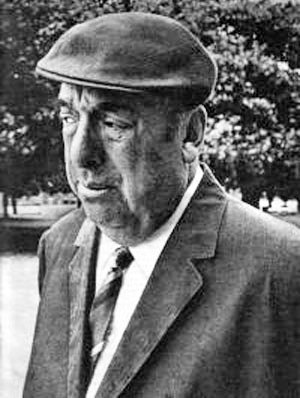
In 1921, he moved to Santiago to study French at the Universidad de Chile with the intention of becoming a teacher, but soon Neruda was devoting himself full time to poetry. In 1923 his first volume of verse, Crepusculario ("Book of Twilights"), was published, followed the next year by Veinte poemas de amor y una canción desesperada ("Twenty Love Poems and a Song of Despair"), a collection of love poems that was controversial for its eroticism, especially considering its author's young age. Both works were critically acclaimed and were translated into many languages. Over the decades, Veinte poemas would sell millions of copies and become Neruda's best-known work.I wonder what he was hoping for?
Neruda had one daughter, Malva Marina Trinidad (1934–1943), living in Gouda, The Netherlands. She died at age eight in 1942. (This was after veinte poemas)
Neruda was good friends with Venezuelan intellectuals and diplomats, such as Arturo Uslar Pietri, Juan Oropeza and Miguel Otero Silva.
Neruda always wrote in green ink because it was the color of Esperanza (hope).
Jan Neruda:
Pablo Neruda chose his pen name in honour of the famous Czech poet Jan Neruda.
Jan Neruda was born in Prague, Bohemia, son of a small grocer who lived in the Malá Strana (Lesser Quarter) district of Prague. After studying philosophy and philology, he worked as a teacher until 1860, when he became a freelance journalist and writer. Neruda never married but had a close relationship to the writer Karolína Světlá.I see a few similarities between Pablo and Jan:
In his work Neruda promoted the idea of rebirth of Czech patriotism. He participated in all the central cultural and political struggles of his generation, and gained a reputation as a sensitive critic. Neruda became, with Vítězslav Hálek, the most prominent representative of the new literary trends.
Neruda was known for his satirical depiction of the petty bourgeois of Prague. His most popular prose work is "Povídky malostranské" (1877, Tales of the Little Quarter), a collection of short stories, which was translated into English in 1957 by the novelist and mystery writer Ellis Peters. Neruda's stories take the reader to the Lesser Quarter, to its streets and yards, shops, churches, houses, and restaurants.
- Both switched from teaching to writing
- Both involved in politics
- Both write in opposition of their government
During the late 1960s, Argentine writer Jorge Luis Borges was asked for his opinion of Pablo Neruda. After describing a brief meeting with him when both were young, Borges stated,This may be interesting to mention if I focus on Neruda's opinion of the impact of voiced words.
"I think of him as a very fine poet, a very fine poet. I don't admire him as a man, I think of him as a very mean man."When asked for the reasons for this, Borges continued,
"Well, he wrote a book -- well, maybe here I'm being political -- he wrote a book about the tyrants of South America, and then he had several stanzas against the United States. Now he knows that that's rubbish. And he had not a word against Perón. Because he had a lawsuit in Buenos Aires, that was explained to me afterwards, and he didn't care to risk anything. And so, when he was supposed to be writing at the top of his voice, full of noble indignation, he had not a word to say against Perón. And he was married to an Argentine lady, he knew that many of his friends had been sent to jail. He knew all about the state of our country, but not a word against him. At the same time, he was speaking against the United States, knowing the whole thing was a lie, no?
Tuesday, April 20, 2010
Step One
I decided yesterday that because of the rush of people that would try to claim their first choice (pretty much anything but poetry) I would let them participate in the furious scramble and go with some good old Pablo Neruda. This is definitely a scary choice, because I am not a huge fan of poetry, and probably not a very smart one, because I am much better at analyzing books than poems. However, I am sort of excited about this because I really enjoy thinking about why Neruda incorporates so many references to nature in his poems.
I am planning on looking at a few (depending on how much I can find within each) poems from Twenty Love Poems and a Song of Despair. I will need to find them online, read them all, and decide which ones I want to use. Since they are all written originally in Spanish, I think I will want to look for all of the poems in English, hopefully translated by the same person. This will give me a more consistent pattern of word choice and style, and I think it will be better to read them as a set of poems translated by one translator than a scattered group written by different people.
--Later--
I found the book here, and I believe this version is translated by Willam Stanley Merwin. I might also refer to this if I feel like seeking out the poem in its original language. However, I should probably stick to just one version in order to stay consistent. (The Spanish version was helpful in the very first poem, where it says "and a love you" in the English translation, but the Spanish version says "te amo," which is "i love you." I was pretty sure that "a love you" was a typo, but I just wanted to double check.
--Later Again--
So far I have read the first 5 poems, and I will finish the rest of them soon.
I noticed a few things that I remember talking about in class previously:
From I
I am planning on looking at a few (depending on how much I can find within each) poems from Twenty Love Poems and a Song of Despair. I will need to find them online, read them all, and decide which ones I want to use. Since they are all written originally in Spanish, I think I will want to look for all of the poems in English, hopefully translated by the same person. This will give me a more consistent pattern of word choice and style, and I think it will be better to read them as a set of poems translated by one translator than a scattered group written by different people.
--Later--
I found the book here, and I believe this version is translated by Willam Stanley Merwin. I might also refer to this if I feel like seeking out the poem in its original language. However, I should probably stick to just one version in order to stay consistent. (The Spanish version was helpful in the very first poem, where it says "and a love you" in the English translation, but the Spanish version says "te amo," which is "i love you." I was pretty sure that "a love you" was a typo, but I just wanted to double check.
--Later Again--
So far I have read the first 5 poems, and I will finish the rest of them soon.
I noticed a few things that I remember talking about in class previously:
From I
- Being "alone"
- "forged you like a weapon" = "like a sword sheathed in meteors"
- talking about her "voice"
- repetition of "thirst"
- "alone in the loneliness"
- "light" "flame" "fire"
- repetition of "hours"
- "voice" again
- repetition of "wind" - also in other poems
- "wave without spray / and substance without weight" - unnatural, impossible
- "grapes" (also in XIII)
- more "wind"
- more "voice"
Subscribe to:
Comments (Atom)
